Hidehiro ISHIZAWA
Staff
Name: Hidehiro ISHIZAWA
Position: Assistant Professor
Degree: Ph.D.
Laboratory: Bio-Environmental Engineering Laboratory
Laboratory URL: http://www.see.eng.osaka-u.ac.jp/wb/ikelab/
Microbial Community Engineering for Next-Generation Environmental Technologies
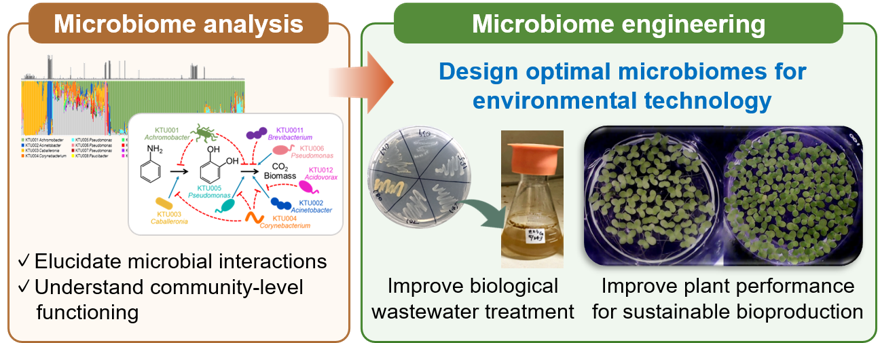
Our daily lives and industrial activities generate various substances that contribute to environmental problems, such as water pollutants and greenhouse gases. We focus on the ability of microorganisms to degrade such substances or convert them into useful resources. In particular, we aim to translate our research into practical environmental technologies by developing approaches to predict and understand the functions of diverse microbial communities through the integration of experiments and data science.
Biomass Production and Water Purification Technologies Using Plant–Microbe Symbiosis
Microorganisms living on plant roots and leaves are closely linked to plant growth and disease resistance. By designing and controlling their functions, it may become possible to cultivate plants in an environmentally friendly manner while reducing dependence on pesticides and chemical fertilizers. We focus particularly on duckweed, an aquatic plant known for having one of the highest growth rates among vascular plants, and are developing technologies for biomass production and water purification by utilizing its symbiotic microorganisms. We are also promoting international collaborations and partnerships with companies by building on the research platform established through these studies.
Publication
- Ishizawa H., Kito M., Noguchi S., Kimura K. Takeo M.: SubCom analysis: dissecting microbial community functions into taxon-specific contributions and interaction contexts. Microbiome, in press.
- Ishizawa H., Noguchi S., Kito M., Nomura Y., Takeo M.: Decoding emergent properties of microbial community functions through sub-community observations and interpretable machine learning. The ISME Journal 19, wraf236 (2025).2. Ishizawa H., Noguchi S., Kito M., Nomura Y., Takeo M.: Decoding emergent properties of microbial community functions through sub-community observations and interpretable machine learning. The ISME Journal 19, wraf236 (2025).
- Ishizawa H., Tashiro Y., Inoue D., Ike M., Futamata H.: Learning beyond-pairwise interactions enables the bottom-up prediction of microbial community structure. Proceedings of the National Academy of Sciences of the United States of America 121, e2312396121 (2024).
- Ishizawa H., Tashiro Y., Okada T., Inoue D., Ike M., Futamata H.: Uncovering the causal relationships in plant-microbe ecosystems: A time series analysis of the duckweed cultivation system for biomass production and wastewater treatment. Science of the Total Environment 957, 177717 (2024).
- Ishizawa H., Onoda Y., Kitajima K., Kuroda M., Inoue D., Ike M.: Coordination of leaf economics traits within the family of the world’s fastest growing plants. Journal of Ecology 109, 2950-2962 (2021).